

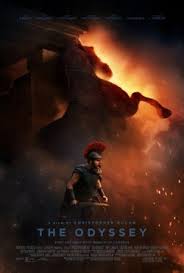
Odysseus, the King of Ithaca (Matt Damon), has not returned from the Trojan War in twenty years. Ithaca is overrun with suitors who wish to marry his wife Queen Penelope (Anne Hathaway) and claim the throne. But Penelope, their son Telemachus (Tom Holland), and their loyal half-blind servant Eumaeus (John Leguizamo) all believe in their hearts that he will return. Telemachus travels with his teacher—and Odysseus's loyal friend—Mentor (Ryan Hurst) to Sparta to speak to King Menelaus (John Bernthal), hoping he will reveal what has happened to Odysseus. The wily suitor Antinous (Robert Pattison) plans to kill Telemachus.
We journey back in time to see how Odysseus created the great wooden horse, filled with warriors, that is left behind to fool the people of Troy. Thought to be a gift from the gods, it is taken inside the Trojan walls and the Greeks, led by Agamemnon (Benny Safdie), the King of Mycenae, emerge and sack the city. Helen (Lupita Nyong'o) is captured. On the way home, Odysseus's crew, searching for supplies, are trapped in a cave and many of them are eaten alive by the giant Polyphemus (Bill Irwin and a giant puppet), but they blind him and most escape. But Polyphemus is the son of Poseidon, God of the Sea, and he makes them pay.
On the Island of Aeaea, Giant Lestrygonians kill most of the crew. The crew rebels and the witch Circe (Samantha Morton) turns them into swine. Odysseus persuades her to change them back and she warns Odysseus that he has to travel to Hell and speak to the seer Teresias (James Remar) in order to find his way home, alone, to Ithaca. The ghost of Agamemnon tells him that his wife Clytemnestra (also Lupita Nyong'o), twin of Helen, murdered him when he returned home in retaliation for the sacrifice of their daughter Iphigenia for good weather.
The crew faces the monsters Scylla and Charybdis, and the Sirens, but they sacrifice the cattle of the Sun God and everyone is killed but Odysseus. He washes ashore on Ogygia and the nymph Calypso (Charlize Theron) keeps him in thrall until she takes pity on him and lets him go seven years later. He surrenders to Poseidon and is washed ashore in Ithaca. He rescues his son Telemachus but is not recognized by anyone but his old dog Argos, who promptly dies happy. He confesses to Penelope and she forgives him. She declares to the suitors that she will marry the man who can use Odysseus's bow to fire an arrow through a series of axe head openings. Only Odysseus, disguised as a beggar, succeeds, and with the help of Telemachus and a few others, he proceeds to kill the suitors. Odysseus cedes his throne to Telemachus and leaves with Penelope for peace in exile.
The film was written and directed by Christopher Nolan, who produced it with his wife Emma Thomas. It was a hell of a job to take on and he acquitted himself with honors, somehow keeping the great war-story, the fantastic adventure, and the powerful love-story juggled together like blazing torches. It was filmed in Morocco, Greece, Sicily, Scotland, Iceland, the Western Sahara, Malta, and Universal Studios in Los Angeles. The entire film was created on IMAX, the first ever done so, for $250 million. It grossed $652 million. Nolan was concerned about following his previous film Oppenheimer, but he need not have worried. Nolan was extraordinarily faithful to the original text, which is pretty much the oldest fantasy story in history.
As a lifelong fan of the story, I was of course blown away. Production designer Ruth de Long and costume designer Ellen Mirojnick are from Oppenheimer. The 36-foot-tall Trojan Horse and the enormous Cyclops puppet blew everyone away. The music was largely produced through genuinely ancient instruments There were, of course, complaints of inaccuracy, the most widely publicized of which was a complaint of Lupita Nyong'o as Helen, on the grounds that the casting was unrealistic. In a film populated by gods and monsters, I'm not sure what unrealistic means. Helen was hatched from a swan's egg, and was once played by Eartha Kitt, in Orson Welles' play Doctor Faustus. Incidentally, Eartha Kitt, because of her opposition to the Vietnam War, was called a sadistic nymphomaniac by the CIA, a singular honor, I'm sure.
The film is not fantastic like a Ray Harryhausen epic, but gritty and realistic like a war-movie, which it is. The gods and monsters, the magic spells, and the justice of the gods are accepted as facts of life. The long revenge scene at the end is as satisfying as it must have been when told over the fire 3000 years ago. Some scenes, like the attack of the Cyclops and the transformation of the sailors into pigs are as scary as anything from a monster movie. Benny Safdie in Agamemnon's black mask and helmet, apparently decorated with a human spinal column, is creepy. And Anne Hathaway as Penelope steals the movie.