
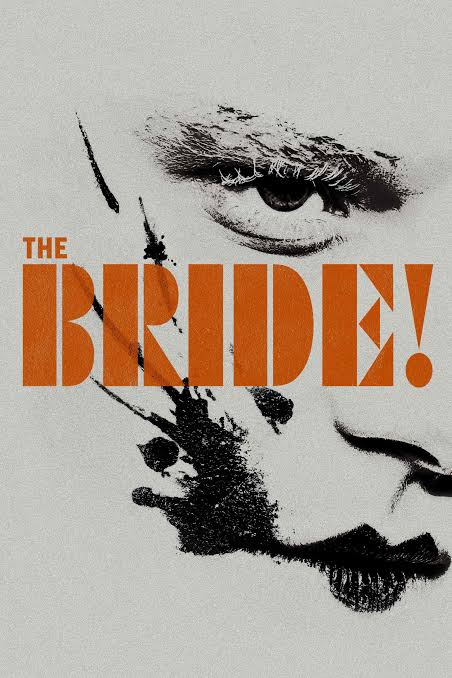
Mary Shelley (Jessie Buckley) speaks to us from the dead (Already we know this isn't the usual sort of movie) revealing that she wants to tell us the later story about the Frankenstein monster, which she wasn't able to write while she lived. She possesses a living woman in 1936 Chicago named Ida (also Jessie Buckley) in a trance. This woman reveals the criminality of crime boss Lupino (Zlatko Buric). His henchmen, Clyde (John Megaro) and James (Matthew Maher) try to kidnap her, but she falls down the stairs and dies.
Meanwhile, in Chicago, Frankenstein's monster, or just Frank, (Christian Bale) is still living and visits the home of scientist Doctor Cornelia Euphronius (Annette Bening), attracted by the scientist's work on reanimation. He wants the Doctor to create a companion for him to cure his loneliness. He chooses Ida's corpse to reanimate, but she loses all her memory. Frank tells her she is his bride and lost her memory in an accident.
Frank and Ida go to the movies and see Frank's favorite actor, Ronnie Reed (Jake Ghyllenhaal) and then go dancing. Two men try to assault her and Frank kills them. She runs away with him, stowing away on a train to New York City and killing a cop in the process. Meanwhile, Detective Jake Wiles (Peter Saarsgaard) investigates and he and his assistant, Myrna Malloy (Penelope Cruz, who may be the best thing in the movie) follow the fugitives to New York.
In hiding, Frank tells Ida her name is Penelope Rogers. She causes a scene at the movie "Revolt of the Zombies" and joins a revolting mob at a high-class party. Frank dances like Reed in his film and Penelope joins him along with several others possessed by Mary Shelley. Detective Wiles arrives with the police but Penelope holds Reed at gunpoint and makes a speech about men abusing women. Wiles recognizes her as Ida. Penelope kills a cop and the couple steal a car and escape.
Their crime-spree becomes famous and mobster Lupino recognizes her face in the newspaper. He kills James for not killing her and sends Clyde to finish the job. Malloy figures out what's happening and Wiles travels to Niagara Falls and finds the fugitive couple. Wiles informs Penelope of her real identity and she shoots him in the foot. Penelope takes Frank to a drive-in where he tells her the truth.
Wiles tells Malloy that he and Ida had been working together to take down Lupino. He decides to retire and promotes Malloy to his job, making her the first female police detective. At the drive-in, Frank apologizes and confirms his love for Penelope, or Ida, whatever, who re-names herself The Bride. But Clyde kills him and the Bride escapes with Frank's body to Doctor Eupronius's laboratory. Euphronius refuses to reanimate Frank and the Bride kills her. Clyde breaks into the lab and kills The Bride. The police arrive and Malloy orders them to go out and search for Clyde, leaving Euphronius alone with the Bride and Frank, who decides to reanimate them. Outside, the police arrest Clyde. The revolting couple holds hands (Awww!). In mid-credits, Lupino and others are approached by Wiles and by Bride-inspired rioters .
The movie was written and directed by Maggie Ghyllenhall, based of course on Mary Shelley's 1818 novel Frankenstein and the 1935 film "Bride of Frankenstein." The CEOs of Warner Brothers paid for it, to the tune of a hundred million dollars, I'm sure because of the brilliant people involved and not because they really expected it to make a profit. Ultimately, it bombed and the studio lost about 90 million. It got about 60% on Rotten Tomatoes. It was loud and brash and it was said to be pieced together like Frankenstein's monster. It was also called "Frankenstein Meets Bonnie and Clyde, with a touch of Sid and Nancy and Natural Born Killers." It was, however, considered for a Fangoria Chainsaw Award.
As a tribute to Mel Brooks and "Young Frankenstein", the Monster and the Bride dance to Puttin' on the Ritz. The creators of the film are all known to dance to another drum from the rest of Hollywood. If you like that sort of thing, it's just the sort of thing you'll like. It might have bored me to tears if I was not in love with everything Frankenstein and fascinated by what the makers did with the story. I believe there are two perfect Frankenstein movies—"Bride of Frankenstein" and "Young Frankenstein". This does not make a third. But I have to admire its determination to not only to push over the top, but to leap there with flags flying. In the hands of less brilliant actors and creators, it would have spun into the drink.